

The Sound of Concentration
There is a moment in batting when noise disappears.
Crowd cheers fade into a distant hum. Fielders become shapes instead of individuals. Even the bowler’s footsteps feel slower. The batter hears only two sounds — breath and ball.
This is not luck. It is extended concentration.
Batting play demands a level of attention that the human mind naturally resists. The brain wants variation, entertainment, distraction. Cricket offers repetition. Over after over, similar actions occur, yet each ball contains a different risk.
The batter trains the mind to stay present.
One mistake many players make is trying to stay focused for the whole day at once. The mind cannot hold six hours of attention in a single effort. Instead, experienced batters divide the innings into tiny segments:
- One ball
- One over
- One spell
- One session
After each segment, they reset mentally. A brief walk down the pitch, a tap of the crease, a glance at the field — small rituals that refresh awareness. These rituals are not superstition; they are mental punctuation marks separating past from future.
Without reset, thoughts accumulate.
Accumulated thoughts become hesitation.
Hesitation becomes dismissal.
Between Deliveries: Where Innings Are Built
Spectators watch the ball. Players manage the seconds when the ball is dead.
The time between deliveries is where batting play matures. Here the batter evaluates:
- Did the ball swing late?
- Was the bounce consistent?
- Did the bowler hide the slower ball?
- Is mid-off moving wider?
These reflections happen quickly and quietly. The batter does not analyze with long reasoning — only sharp recognition. Like reading expressions in conversation.
Good players play the ball they faced. Great players prepare for the next one before it exists.
Body language also matters. A rushed batter invites pressure. A composed batter spreads calmness. Bowlers sense this. Cricket psychology flows through posture more than words.
Standing tall after a play-and-miss is sometimes stronger than hitting a boundary nervously.
Building an Innings: The Three Phases
Every long stay at the crease usually passes through three natural stages.
1. Survival
The beginning is fragile. Edges carry. Timing is uncertain. The batter’s only aim is understanding — not domination. Leaves, blocks, soft hands. Risk stays low.
2. Stability
After adjustment, strokes expand. Singles come easily. The ball appears clearer. The batter rotates strike and frustrates bowlers. Partnerships grow here.
3. Authority
Only after long presence does command emerge. Now the batter chooses scoring areas deliberately. Field placements dictate shots, not the other way around. Boundaries arrive without desperation.
Many players try to begin at stage three and never reach it. Batting play respects progression.
Handling Pace
Fast bowling introduces instinctive fear — speed aimed at the body. The natural reaction is retreat or panic. Skilled batting replaces fear with structure.
Against pace, the eyes lead everything. The batter watches the seam, not just the ball. The seam position hints movement direction. Upright seam suggests swing; scrambled seam hints unpredictability.
Balance becomes protection. A still head keeps vision steady. When the head falls away, control disappears. The bat follows the head — always.
Hook and pull shots represent confidence but require judgment. Not every short ball deserves aggression. Sometimes the bravest action is sway and leave.
Courage in batting play is not reckless hitting.
Courage is correct decision despite threat.
Late Play: The Advanced Skill
One of the highest techniques in batting is playing the ball late — meeting it close to the body rather than far in front.
Late contact achieves three advantages:
- Swing and seam movement complete before impact
- Edges drop shorter
- Direction control improves
To play late, the batter must trust reflexes. Beginners hit early seeking certainty; experts delay seeking accuracy.
This single adjustment transforms survival into reliability.
Field Awareness
Runs do not exist randomly — they exist in spaces.
A batter studies field placement continuously. Every fielder reveals bowler intention. A packed off-side invites leg-side scoring. A deep square leg protects the pull but opens singles elsewhere.
Batting play becomes a map reading exercise. Instead of forcing strokes into crowded regions, the batter redirects scoring naturally.
Rotating strike is often easier than hitting boundaries. Bowlers prefer facing the same batter repeatedly to build pressure. A quick single breaks rhythm more effectively than a risky drive.
Small decisions accumulate into large totals.
The Role of Fitness
Batting appears stationary, but endurance defines long innings. Concentration drains energy; dehydration weakens reactions. Tired legs slow footwork by fractions — enough for edges.
Running between wickets especially tests discipline. The first run is speed; the second is awareness; the third is communication.
A tired batter stops calling loudly. Misunderstandings follow. Many partnerships end not by bowling brilliance but by exhausted judgment.
Thus batting play includes stamina. The mind performs only as long as the body supports it.
When Bowlers Change Plans
A quality bowling side never stays predictable. After patience frustrates them, they alter tactics — around the wicket, defensive fields, slower pace.
This stage challenges ego. The batter who was scoring freely suddenly receives only defensive lines. Boundaries disappear.
Here maturity matters: accept slower scoring.
Forcing shots restores the bowler’s advantage. Waiting restores the batter’s.
Cricket often rewards the player willing to be temporarily quiet.
The End of the Innings
Every innings concludes — wicket, declaration, or target achieved. The final moments often bring reflection while still at the crease.
The batter senses fatigue, satisfaction, or regret even before leaving the field. A well-built innings feels controlled regardless of score. A rushed innings feels incomplete even if runs were quick.
Batting play therefore is not judged only by numbers but by clarity of decisions made ball after ball.
In the end, the walk back to the pavilion carries the true evaluation — not applause, not statistics, but inner understanding of how well the contest was played.
And the next time the player walks out again, the process begins fresh: one pitch, one bowler, one ball, one decision.
Batting Against Spin in the Later Stages

As the match progresses and the ball softens, spin often takes control of the game. The pitch wears, footmarks appear, and suddenly the batter must negotiate not just turn but unpredictability. Early in an innings, spin tests technique. Later, it tests character.
In long stays at the crease, a batter learns that spin bowling is less about the ball spinning sharply and more about doubt spinning inside the mind.
A spinner survives on hesitation.
The ball may not turn every delivery. In fact, many deliveries go straight. Yet the batter cannot assume straightness because the turning ball may arrive next. This uncertainty forces constant recalibration.
To handle this, experienced players simplify their thinking:
- Forward press early
- Watch the hand, not the pitch
- Decide before bounce, not after
Waiting for the ball to turn and then reacting is already late. Batting play against spin depends on pre-decision — commit forward or back quickly and trust the choice.
When a batter becomes stuck on the crease, neither forward nor back, spin becomes dangerous. Edges appear, pads come into play, and pressure grows. Movement is safety.
Using the Depth of the Crease
Many believe advancing down the pitch is the only answer to spin. Equally powerful is moving backward.
By going deep into the crease, the batter converts a good length ball into a shorter one. The spin remains, but its threat reduces because the bounce is controlled at a lower height.
This method achieves two purposes:
- Forces the spinner to bowl fuller
- Creates cut and pull opportunities
The contest becomes spatial. Instead of reacting to turn, the batter manipulates length.
Batting play often rewards subtlety over spectacle. A gentle back-foot punch for a single can dismantle a spinner’s plan more effectively than an attempted lofted shot.
The Emotional Middle Phase
Every innings has a period where scoring slows. Bowlers tighten lines, fielders crowd, and even well-timed shots find hands. This is the emotional middle phase — the time when frustration quietly builds.
The scoreboard moves slowly. The batter feels “stuck.”
This phase decides whether an innings becomes memorable or ordinary.
Impatience whispers: force a boundary.
Discipline replies: wait for change.
Great batters understand that pressure in cricket behaves like weather — it passes. A single loose delivery often follows several tight ones. But only the patient batter is ready for it.
Batting play is the ability to endure monotony without inventing risk.
Communication with the Non-Striker
Running between wickets is not merely physical effort but coordinated thinking. Two players separated by twenty-two yards must act as one mind.
Calls must be early and clear. Hesitation creates half-runs, the most dangerous movement in cricket.
Experienced partners develop rhythm:
- Immediate “yes” or firm “no”
- Turning quickly without looking back too long
- Trusting the partner’s judgment
The best partnerships feel effortless because decisions are made before panic can appear.
A direct hit run-out often comes from late commitment, not fast fielding. Batting play therefore includes decisive communication — a mental skill disguised as running.
Managing the Tailenders
When batting with lower-order players, responsibility shifts. Strike management becomes crucial. The recognized batter shields the partner from difficult bowlers while still scoring.
This requires calculation each over:
- How many balls remain?
- Which deliveries carry lowest risk?
- When to take a single?
Here batting turns strategic. The batter is not just playing for runs but for time and opportunity. Sometimes refusing a single early in the over is smarter than accepting it.
Batting play expands from personal survival to team protection.
Reading Fatigue in Bowlers
Just as batters tire, bowlers do too — and fatigue changes behavior.
A tired bowler shortens the run-up slightly. The pace drops subtly. Accuracy fades. Fielders adjust automatically.
An alert batter notices these signs. Instead of pre-planned aggression, they respond naturally to opportunity. Boundaries often come not from forcing but from recognizing decline in precision.
Cricket rewards observation. The game constantly provides clues to those patient enough to notice.
Handling Close Fielders
When spinners attack, fielders surround the bat — slip, silly point, short leg. Their presence adds psychological pressure. Every defensive shot echoes louder.
The batter must detach from proximity. Thinking about fielders invites mistakes. Focus returns to the ball alone.
Soft hands become essential. Rather than pushing at the ball, the bat absorbs impact. The goal is not dominance but quiet control.
Batting play here resembles negotiation rather than combat — agreeing to safety until risk naturally reduces.
The Long Stay Mindset
After hours at the crease, the mind changes state. Movements feel automatic, yet danger increases because familiarity breeds casualness.
Many dismissals occur after milestones — fifty, hundred, or long defensive phases — when concentration dips briefly. The brain seeks relief after achievement.
Elite batters counter this by restarting mentally after every landmark. The score resets internally to zero. They treat the next ball as the first of the day.
Longevity in batting depends on renewing hunger repeatedly within the same innings.
The Final Overs of a Session
Approaching lunch, tea, or close of play, bowlers intensify effort knowing a break approaches. Batters must adjust awareness accordingly.
The mistake is relaxing early.
The final minutes often demand sharper focus than the previous hour. Surviving these periods builds psychological advantage because bowlers lose momentum during the break.
Batting play respects timing not only within overs but within the day itself.
Memory and Learning
After the match, experienced players replay certain deliveries mentally — not obsessively, but constructively. They remember what worked under pressure and what failed under similar conditions.
Improvement comes less from quantity of practice and more from clarity of recall. Each innings adds a small adjustment: a later leave, a calmer single, a steadier head position.
Gradually, batting becomes less reactive and more intuitive. Experience compresses thought into instinct.
The Ever-Renewing Contest
No batter solves cricket permanently. Each new pitch erases previous comfort. Each new bowler asks fresh questions. Confidence helps but cannot replace attention.
That uncertainty keeps batting alive as a craft rather than a solved skill.
Every time the player takes guard again, the process restarts — reading conditions, building rhythm, controlling emotion. Past runs offer reassurance but not protection.
Batting play is therefore an ongoing conversation between learning and forgetting, memory and adaptation.
And that is why even after countless innings, the walk to the crease still carries anticipation — the possibility that today the balance between judgment, patience, and timing might align perfectly once more.
The Battle with the New Ball Again
Even after spending hours batting, a player may face a second new ball. The field resets, the shine returns, and suddenly the contest resembles the beginning again — but with tired legs and a used pitch.
This moment tests technique more than courage.
The ball now moves faster off the surface. Small cracks may have opened. Swing combines with uneven bounce. The batter who was comfortable against spin must re-tighten defense against seam.
Batting play demands the ability to rewind habits. Aggressive strokes from earlier phases are paused. The stance becomes slightly more compact. The bat comes closer to the body again.
Experienced players almost “restart” their innings mentally. They treat the new ball as if they have just arrived at the crease — leaving wider deliveries, watching carefully, respecting uncertainty.
Longevity in batting is not continuous attack; it is repeated adjustment.
Silence Before Milestones
Approaching a personal milestone — fifty, hundred, or any landmark — introduces a unique tension. The crowd senses it. Teammates wait. The batter becomes aware of numbers that previously did not matter.
Suddenly, routine decisions feel heavier.
Many players get dismissed here because attention shifts from process to outcome. The mind calculates celebration instead of evaluating the ball.
The solution is simplicity. Good batters reduce thinking:
- Watch seam
- Move feet
- Play late
Nothing else changes.
Runs do not arrive faster because they are close to a milestone. They arrive when the next correct decision is made. Batting play survives pressure by shrinking focus back to basics.
Controlling the Tempo
An innings has rhythm like music. Sometimes it flows quickly, sometimes slowly. The batter influences this tempo deliberately.
Against accurate bowling, slowing the game helps — longer routines, deeper breaths, careful preparation. Against defensive bowling, increasing tempo breaks patterns — quicker singles, sharper running, forcing field adjustments.
Tempo is a subtle weapon. It disturbs bowler comfort without visible aggression.
Instead of attacking shots, the batter manipulates time. Bowlers prefer predictability. When rhythm changes, their lengths change too.
Batting play includes managing pace of the contest, not just pace of scoring.
Facing Reverse Swing
Late in the day, with an older ball, reverse swing may appear. The ball moves opposite to conventional expectation, often late and sharply.
This phase rewards compact technique. Big backlifts and expansive drives become risky. The bat path shortens. The focus shifts under the eyes.
The batter plays straighter, allowing less gap between pad and bat. Instead of pushing forward heavily, balance remains centered to react both ways.
Here patience again becomes scoring method. Bowlers searching for wickets often overpitch. Straight drives and flicks emerge naturally when alignment stays correct.
Batting play turns defense into opportunity.
Recovering After a Mistake
Every long innings contains at least one error — a misjudged pull, a thick edge, a near run-out. Survival after a mistake requires mental recovery.
The immediate reaction is embarrassment or anger. But carrying that emotion into the next ball creates another mistake.
Experienced players pause. They walk away, mark the pitch, reset breathing. Within seconds they detach from the previous delivery completely.
Cricket offers constant redemption because each ball is independent. A batter who treats events separately maintains clarity. One who links them builds pressure internally.
Batting play values emotional reset as much as technical correction.
The Influence of Field Changes
Captains constantly reposition fielders to provoke shots. A new gap tempts the batter; a closed region challenges pride.
The disciplined batter does not respond instantly. They observe whether the change is bait or necessity.
For example, a wider mid-off may invite the drive but also protect a mistimed loft. A deep square leg may encourage a pull yet wait for a top edge.
Instead of reacting to space, the batter reacts to delivery quality. Good balls are defended regardless of gap. Loose balls are scored regardless of field.
Thus, decisions remain ball-based, not temptation-based.
Energy Management
A long innings stretches beyond skill into endurance planning. The batter conserves energy intentionally:
- Relaxing grip between balls
- Walking calmly instead of rushing
- Hydrating regularly
- Breathing deeply before facing up
These small habits prevent mental fatigue. Exhaustion reduces reaction speed and clarity more than technique does.
Batting play recognizes that concentration is physical as well as mental. A calm body supports a sharp mind.
Anticipating the Endgame
As the match situation evolves — approaching declaration, chase, or draw — objectives shift. The batter must adapt priorities quickly.
Sometimes time matters more than runs. Sometimes runs matter more than safety. The method changes but discipline remains.
The key is clarity: understanding the team’s requirement before the ball is bowled. Confusion leads to half-committed strokes.
When purpose is clear, shot selection becomes simpler. The batter either blocks with conviction or attacks with conviction — never in between.
Respecting the Unplayable Delivery
Occasionally a bowler produces a perfect ball — precise line, late movement, ideal length. Even flawless technique might fail.
Batting play includes acceptance of such moments. Not every dismissal indicates error. Recognizing this protects confidence for future innings.
Players who chase perfection fear risk excessively. Players who accept inevitability maintain freedom.
Cricket’s difficulty gives value to resilience more than flawlessness.
Walking Off the Field
After the innings ends, the journey back carries layered emotion — relief, satisfaction, or lessons waiting quietly. Teammates applaud, but the batter remembers individual deliveries vividly.
Certain balls remain clear: the early leave that settled nerves, the partnership single that built momentum, the defensive stroke that changed the session.
These memories form experience. Not statistics, but decisions.
Batting play therefore continues even after leaving the pitch — in reflection, adjustment, and preparation for the next challenge.
Because the next innings will begin exactly the same way:
one bowler running in, one ball approaching, and one mind deciding again how to respond.
The Continuity of Batting Play
Batting play does not truly end with an innings. It continues in memory, in preparation, and in anticipation of the next time a player takes guard. Every experience reshapes future batting play. Each ball faced becomes a reference for the next decision.
A batter who understands batting play knows improvement happens between matches as much as during them.
The player revisits situations mentally:
- How batting play handled swing
- How batting play adapted to spin
- How batting play reacted under pressure
- How batting play changed tempo
This reflection strengthens awareness. The goal is not remembering every run, but remembering every decision.
Repetition and Refinement in Batting Play
Training sessions are where batting play becomes automatic. Nets are not merely for hitting balls; they are for repeating correct movement until reaction replaces thought.
In batting play practice, the player focuses on:
- Consistent head position
- Early foot movement
- Soft hands in defense
- Balanced follow-through
Repetition creates familiarity. Familiarity creates calmness. Calmness allows batting play to function under match pressure.
Many players practice strokes. Skilled players practice judgment. They leave balls deliberately, defend intentionally, and simulate match conditions mentally. The more realistic the preparation, the more natural batting play feels in competition.
Batting Play and Decision Speed
Cricket allows less than half a second for reaction. Therefore batting play depends on reducing decisions, not increasing them.
The batter pre-plans options:
If full — drive or defend
If short — sway or pull
If turning — forward or back
Because these choices are prepared, batting play becomes quick. Hesitation disappears. The mind recognizes patterns faster.
Decision speed is confidence in preparation. Without preparation, batting play slows, and slow decisions create edges.
Emotional Control in Batting Play
Emotion influences every action at the crease. Excitement after boundaries, frustration after dot balls, tension during tight chases — all attempt to disrupt batting play.
A stable batter maintains emotional neutrality. Not emotionless, but controlled.
After a boundary, batting play returns to patience.
After a miss, batting play returns to trust.
After pressure, batting play returns to breathing.
The player who reacts emotionally changes technique unconsciously. The player who resets emotionally protects consistency.
Thus batting play is mental discipline disguised as physical skill.
Batting Play Under Target Pressure
During a chase, batting play becomes calculation. The batter measures required runs, overs remaining, and bowling resources.
But effective batting play does not chase the entire target at once. It breaks the task:
- This over: minimal risk
- Next over: scoring opportunity
- Final overs: controlled aggression
By dividing the goal, batting play prevents panic. Each ball remains an individual contest rather than part of an overwhelming number.
Pressure reduces when attention narrows. Batting play thrives in narrow focus.
Shot Selection Within Batting Play
Every delivery offers multiple possible strokes, but batting play selects only the safest productive option.
A wide half-volley may still be left if field placement traps it. A good length ball may be guided instead of driven. The batter chooses based on probability, not temptation.
Shot selection in batting play follows hierarchy:
- Survival
- Rotation
- Boundary
When players reverse this order, wickets fall quickly. When players respect this order, innings grow naturally.
Adaptability: Core of Batting Play
Conditions change constantly — new bowler, reversing ball, rough pitch, fading light. Batting play adapts continuously.
A batter who scored freely earlier may now defend more. A cautious start may later expand into strokeplay. Flexibility prevents stagnation.
Rigid technique struggles; adaptable batting play succeeds.
Adaptation includes:
- Adjusting guard position
- Altering backlift height
- Changing scoring areas
- Modifying trigger movement
Small changes preserve control across varying situations.
Communication Inside Batting Play
Partners influence batting play significantly. They share observations and support composure.
Simple exchanges matter:
“Ball holding low.”
“Spinner quicker.”
“Plenty of time.”
These words reinforce confidence. Batting play strengthens when both batters think collectively instead of individually.
Running calls also reflect trust. Early decisions reduce risk. Decisive communication becomes part of batting play rhythm.
The Patience Cycle in Batting Play
An innings repeatedly cycles between quiet phases and scoring phases. Batting play accepts these waves rather than resisting them.
Quiet overs allow bowlers to search. Eventually they err. Prepared batters capitalize. Then quiet returns again.
Understanding this cycle prevents unnecessary aggression. The batter knows opportunity will come naturally.
Batting play therefore becomes waiting with readiness, not waiting with passivity.
Concentration Renewal in Batting Play
Long innings challenge attention repeatedly. Batting play restores focus using routines:
- Tapping the crease
- Looking at the field
- Controlled breathing
- Resetting stance
These actions anchor awareness. Without them, thoughts drift toward past mistakes or future outcomes.
Each ball must feel like the first. Batting play depends on fresh attention regardless of duration.
Closing Reflection on Batting Play
Batting play ultimately represents disciplined decision-making across changing conditions. Technique supports it, but awareness drives it. Physical ability initiates it, but mental clarity sustains it.
From first defensive block to final scoring stroke, batting play follows the same principle: respond correctly to the present delivery.
No innings is identical. No pitch repeats exactly. Yet batting play remains constant — observe, decide, execute, reset.
And when the player walks out again, batting play begins anew, carrying lessons forward while demanding complete attention once more to the single ball approaching the bat.
Batting Play in Different Match Situations
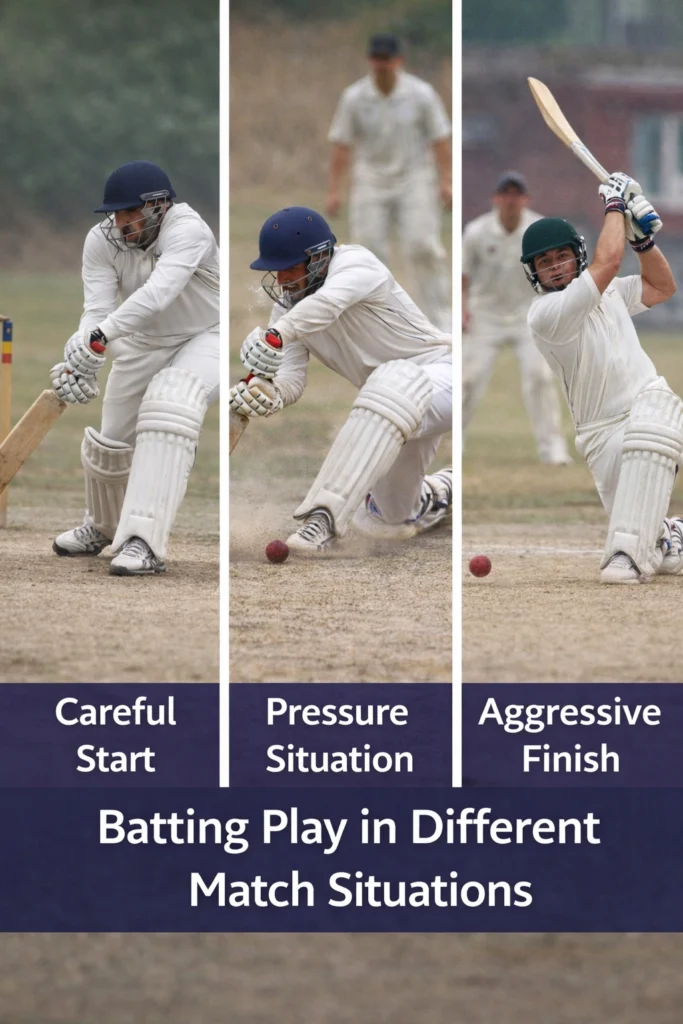
Batting play changes character depending on the situation of the match. The technique may remain similar, but intention transforms completely. A batter who understands batting play adjusts purpose before adjusting stroke.
When the team loses early wickets, batting play becomes protective. The batter values time more than scoring rate. Every leave, every block, every single contributes to rebuilding stability. Here batting play is about restoring belief — not only personal confidence but dressing-room confidence.
When the team is strong and wickets are in hand, batting play expands. The batter explores scoring options, pressures bowlers, and accelerates naturally. Yet even in attack, structure remains. Controlled aggression belongs to batting play; reckless hitting does not.
When saving a match, batting play becomes endurance. Minutes matter more than runs. The batter measures overs survived rather than boundaries struck. Concentration deepens because reward is survival itself.
Thus batting play is situational awareness expressed through technique.
The Role of Awareness in Batting Play
Awareness operates on three levels within batting play:
Ball awareness – line, length, movement
Field awareness – gaps, catching positions, saving angles
Game awareness – score, time, pressure
Beginners focus only on the first. Experienced players balance all three simultaneously. The mind processes them almost subconsciously.
For example, a simple defensive shot may still be placed intentionally away from a close fielder. A soft push may be directed toward the weaker thrower. Even defense contains strategy inside batting play.
Awareness transforms survival into control.
Recovering Rhythm in Batting Play
Sometimes a batter loses timing — the ball reaches the bat slightly earlier or later than expected. Instead of forcing big strokes, batting play rebuilds rhythm quietly.
The batter returns to basics:
- Play straight
- Take singles
- Watch closely
- Shorten backlift
Gradually the connection improves. Once rhythm returns, strokes expand again. This rebuilding phase is essential. Players who skip it attempt boundaries immediately and risk dismissal.
Batting play respects progression back into comfort just as it respects progression at the start.
Batting Play and Body Balance
Balance is the physical foundation of batting play. When the head stays steady, the eyes remain level, and judgment improves automatically.
Poor balance creates multiple problems:
- Edges through slips
- Mistimed drives
- Late reactions
- Weak defense
Therefore skilled batters prioritize posture before stroke. Even aggressive shots come from controlled body position. Power without balance loses direction.
Every delivery begins with stillness. Batting play grows from stability.
Anticipation Without Guessing
Batting play includes prediction but never blind guessing. The batter reads patterns instead of assuming outcomes.
A bowler who delivered three outswingers may bowl an inswinger next — but the batter stays ready for both. Preparedness replaces prediction.
The difference is subtle yet critical:
Guessing commits early.
Anticipation stays flexible.
Flexible readiness allows adjustment after release. Batting play therefore remains reactive while appearing proactive.
The Influence of Confidence on Batting Play
Confidence changes perception of pace and movement. A confident batter sees the ball clearer and reacts smoother. However confidence must come from process, not recent success alone.
If confidence depends only on scoring runs, one failure breaks it. But when confidence depends on preparation and correct decisions, batting play stays stable even after dismissal.
True confidence in batting play means trusting technique regardless of outcome.
Handling Verbal and Crowd Pressure
Noise surrounds the batter — fielders appealing, crowd reacting, situations intensifying. Batting play filters this distraction.
The batter narrows hearing intentionally. Instead of reacting emotionally, they anchor attention to routine: stance, breath, sight of seam.
External pressure attempts to speed thinking. Batting play slows thinking deliberately. Calmness becomes defense.
When attention returns to the ball alone, distractions fade naturally.
The Responsibility Phase
Near the end of an innings, responsibility increases. The batter may guide the lower order or finish a chase. Here batting play balances caution and initiative.
Risk calculation becomes sharper:
- Which bowler to attack
- Which over to defend
- When to rotate strike
- When to refuse singles
Decisions carry greater consequence. The batter relies on accumulated understanding from earlier overs. Long innings provide information; the end phase uses it.
Batting play rewards those who learn continuously during their stay.
Learning Through Each Delivery
Every ball provides feedback. A slight inside edge reveals movement. A mistimed push reveals pace change. A comfortable defense reveals control.
Good batters ignore failures emotionally but not technically. They adjust quietly — half a step forward, softer grip, later contact.
These micro-adjustments define batting play. Improvement occurs ball by ball rather than match by match.
The Endless Renewal of Batting Play
No mastery in cricket remains permanent. Each innings begins with uncertainty again. Past performance offers reassurance but not guarantee.
Therefore batting play is humility in action — respecting every delivery equally whether at zero or a hundred.
The craft never finishes developing. Conditions evolve, bowlers innovate, formats change. Yet the essence remains: observe carefully, decide calmly, execute cleanly.
And once more, as the bowler turns at the top of the run-up, batting play returns to its simplest form — a player, a bat, a ball, and a decision made in a heartbeat.
Batting Play in the Final Session
The last session of a day’s play carries a different weight. Fatigue spreads across both teams, shadows lengthen, and concentration becomes fragile. Batting play now relies more on discipline than flair.
A batter who has survived the earlier hours must resist comfort. Many players relax subconsciously late in the day, assuming the hardest work is done. But cricket often hides its toughest moments at the end.
In this phase batting play simplifies again:
- Watch the ball closely
- Play straighter
- Avoid unnecessary strokes
The aim is continuity. The next day begins from the position preserved now. Each defensive shot near stumps becomes valuable.
Adjusting to Fading Light
As natural light reduces, visibility changes subtly. The ball appears slightly later, especially against darker backgrounds. Batting play compensates through earlier preparation.
The batter shortens movements and delays commitment. Instead of pushing forward strongly, they stay balanced longer. Leaves become safer options than risky drives.
Here restraint equals skill. Recognizing conditions early prevents rushed errors.
Concentration Fatigue
Mental tiredness differs from physical tiredness. The body may still respond well, yet the mind begins drifting. Batting play requires recognizing this drift quickly.
Signs include:
- Late reaction to length
- Forgetting routine between balls
- Feeling rushed without reason
When noticed, the batter deliberately slows the game — walking away, adjusting gloves, breathing deeply. These actions rebuild attention.
Batting play protects focus the same way defense protects the wicket.
Protecting a Set Score
After long effort, the batter reaches a substantial score. Ironically this is when risk increases. Satisfaction weakens vigilance.
Experienced players treat the score as irrelevant. The next ball holds equal importance as the first. Batting play continues unchanged regardless of achievement.
Consistency of mindset prevents emotional drop in sharpness.
Field Spread and Opportunity
Late in the day captains often spread the field to limit boundaries. This presents singles easily. Batting play uses these to retain strike and keep momentum.
Gentle placement replaces force. The batter guides the ball into open areas instead of hitting over fielders. Efficiency becomes priority.
Small runs maintain control of the game’s tempo.
When the Bowler Attacks One Last Time
Before stumps, bowlers frequently attempt a final aggressive spell. Short balls, fuller yorkers, surprise variations — all appear together.
Batting play answers with clarity. Instead of counter-attacking impulsively, the batter returns to tight technique. The earlier aggression of the innings pauses. Survival again becomes central.
Many memorable innings include a tense final over survived calmly rather than a boundary struck boldly.
Returning Next Day
If the batter remains not out overnight, a unique reset occurs. Despite yesterday’s long stay, the next morning feels like a fresh start. Early overs again demand caution.
Batting play repeats its opening principles:
- Observe conditions anew
- Rebuild timing gradually
- Respect the first spell
Continuity depends on respecting the restart.
Lessons Carried Forward
After the match, batting play becomes reflection. Players identify patterns:
- Which deliveries caused discomfort
- Which methods restored control
- How concentration fluctuated
This reflection shapes future preparation. Improvement does not come from playing many innings alone, but from understanding them.
Each experience adds a small refinement — a calmer leave, a clearer call, a steadier stance.
Batting Play as a Lifelong Skill
Even experienced players continue learning. Younger players rely on reaction; seasoned players rely on recognition. Yet both depend on attention to the present ball.
Batting play never becomes automatic entirely. Every pitch presents new behavior. Adaptation remains constant.
The beauty of batting lies in this balance — familiarity of technique combined with unpredictability of conditions.
Final Thought
At its core, batting play is a sequence of correct responses repeated patiently. Not brilliance every ball, but judgment every ball.
The scoreboard eventually records runs, but the true success lies in decisions made calmly under pressure. Each delivery offers uncertainty, and batting play answers with awareness.
And when the next match begins, nothing carries over except learning. The player marks guard again, watches the bowler approach, and once more trusts the quiet process — see, decide, play.
Batting Play in the Modern Viewing Era
Today batting play is not experienced only on the field — it is followed ball-by-ball by millions watching live coverage. Every defensive block, every leave outside off stump, and every calculated single becomes part of a wider narrative. Fans analyze batting play in real time, studying technique, temperament, and decision making as the innings unfolds.
For viewers who follow matches regularly on platforms like
t20worldcup, batting play becomes easier to understand because every phase of the innings can be observed closely — the cautious start, the middle overs control, and the final acceleration. Watching complete passages of play helps people notice something important: great batting play is rarely about constant boundaries; it is about controlling risk over long periods.
Live viewing reveals how players adjust repeatedly:
- Changing guard after swing appears
- Rotating strike when field spreads
- Slowing scoring during tight spells
- Accelerating only when bowlers miss length
Seeing these transitions ball-by-ball shows the intelligence behind batting play rather than just the highlights.
Observing Decision Making
Careful observation teaches that batting play depends more on choices than power. A batter may leave five balls in a row, defend three, then score one controlled boundary. The scoreboard moves slowly, yet control increases.
External cricket discussion spaces such as mahadevcasino often host conversations where fans debate shot selection and match awareness. These discussions highlight how spectators gradually learn to appreciate patience — understanding why a dot ball can sometimes be as valuable as a four.
Because batting play unfolds over time, following full overs rather than short clips helps viewers recognize patterns:
- Bowlers setting traps
- Batters refusing temptation
- Pressure shifting gradually
Cricket becomes less about single moments and more about sequences.
Learning Batting Play Through Observation
Regularly watching extended match coverage allows anyone to notice details professionals rely on:
- How often top batters leave the ball
- How rarely they hit against movement early
- How they rebuild rhythm after mistakes
- How partnerships grow through singles
These lessons cannot be captured in highlight reels alone. Batting play reveals itself only through continuity — the accumulation of disciplined decisions.
By observing patiently, viewers begin predicting choices before they happen. That awareness mirrors what players themselves develop: anticipation built on patterns.
Understanding the Flow of an Innings
An innings usually follows a structure visible to attentive viewers:
- Careful beginning
- Stable middle phase
- Controlled expansion
Watching this full progression helps explain why sudden aggression often fails. Batting play rewards gradual authority. When fans follow matches ball-by-ball rather than only the final score, they see the reasoning behind each action.
The appreciation of cricket deepens because the audience starts thinking like the batter — evaluating risk, field placement, and timing.
The Viewer’s Connection to Batting Play
Modern coverage allows spectators to experience the mental side of cricket. They sense tension during tight spells and relief when a batter breaks pressure with a single. Over time, viewers learn that batting play is not just striking the ball but managing uncertainty.
By consistently observing entire passages of play and discussing them, fans understand why the simplest stroke — a straight defensive shot — can be the foundation of a great innings.
Batting play therefore extends beyond the pitch. It becomes a shared understanding between player and observer, built through attention, patience, and recognition of small decisions shaping big outcomes.
Frequently Asked Questions (FAQ) – Batting Play
Q1. What is batting play in cricket?
Batting play refers to the complete approach a batter uses at the crease — including technique, timing, shot selection, footwork, concentration, and decision-making. It is not only about hitting runs but about managing risk and controlling the game situation ball by ball.
Q2. Why is timing more important than power in batting play?
Timing allows the batter to use the bowler’s pace effectively. A well-timed shot travels faster with less effort and reduces the chance of mistakes. Power without timing often leads to mistimed strokes and dismissals.
Q3. How do professional batters stay focused for long innings?
They divide the innings into small segments — one ball, one over, or one spell at a time. They also use routines like tapping the pitch, adjusting gloves, and deep breathing to reset concentration after every delivery.
Q4. What is the role of footwork in batting play?
Footwork helps the batter reach the correct position to play safely. Moving forward smothers swing or spin, while moving back gives more time to judge bounce. Good footwork reduces uncertainty and improves control.
Q5. How should a batter handle fast bowling?
By watching the seam closely, keeping the head steady, and playing the ball late. Defensive technique and balanced stance are more important than aggressive shots, especially early in the innings.
Q6. How is batting play different against spin bowling?
Against spin, movement becomes more important than speed. The batter uses the crease — stepping forward or backward — to control turn and length instead of relying purely on reaction time.
Q7. Why do batters leave so many balls outside off stump?
Leaving good deliveries forces the bowler to change line and bowl closer to the stumps, which eventually creates scoring opportunities. Patience builds pressure on the bowler.
Q8. What causes most batting mistakes?
Hesitation and poor decision-making. Many dismissals happen not due to lack of skill but because the batter commits too late or plays a shot against the match situation.
Q9. How do batters play under scoreboard pressure?
They break the target into small goals, focusing on one over at a time instead of the entire score. This reduces anxiety and keeps decision-making clear.
Q10. Can batting play be improved without playing matches?
Yes. Visualization, shadow practice, watching full match passages, and analyzing decisions help improve judgment and awareness — which are core parts of batting play.
Q11. What is the most important quality for good batting play?
Consistency in decision-making. Technique matters, but the ability to repeatedly choose the right option for each ball defines a successful batter.
Q12. Why do experienced batters restart carefully the next day even after scoring big runs?
Because conditions change and concentration resets overnight. They treat the next morning like a fresh start to rebuild rhythm and avoid careless mistakes.
